
AI crypto scams red flags checklist 2026 – Indi Crypto

How to Spot AI Crypto Scams in 5 Minutes


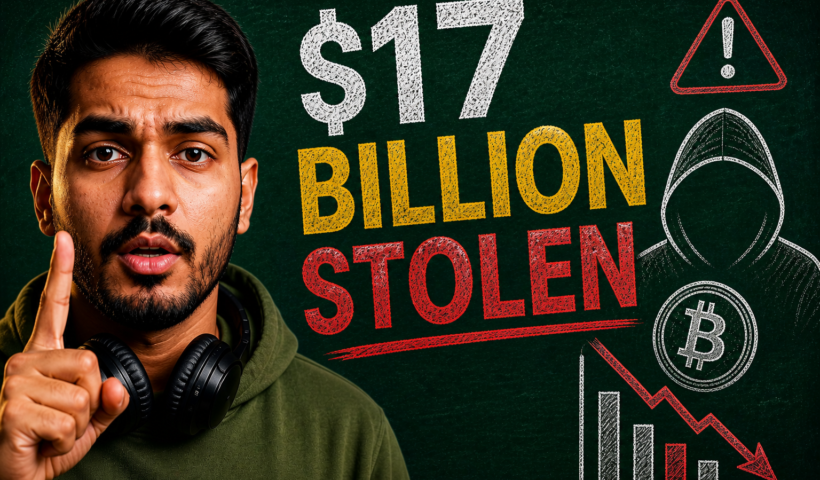
Scammers just stole $17 billion from crypto investors in 2025 alone — and artificial intelligence is the reason it’s harder than ever to tell the difference between a legitimate project and a sophisticated fraud.

AI hasn’t invented new scam types. It has weaponised old ones, making fake teams, fake bots, fake celebrity endorsements, and fake trading platforms look indistinguishable from the real thing. The good news? You can still spot the warning signs — if you know what to look for and take five focused minutes before you send a single cent.

This is Indi Crypto’s battle-tested 5-minute checklist. Bookmark it. Run it every time.
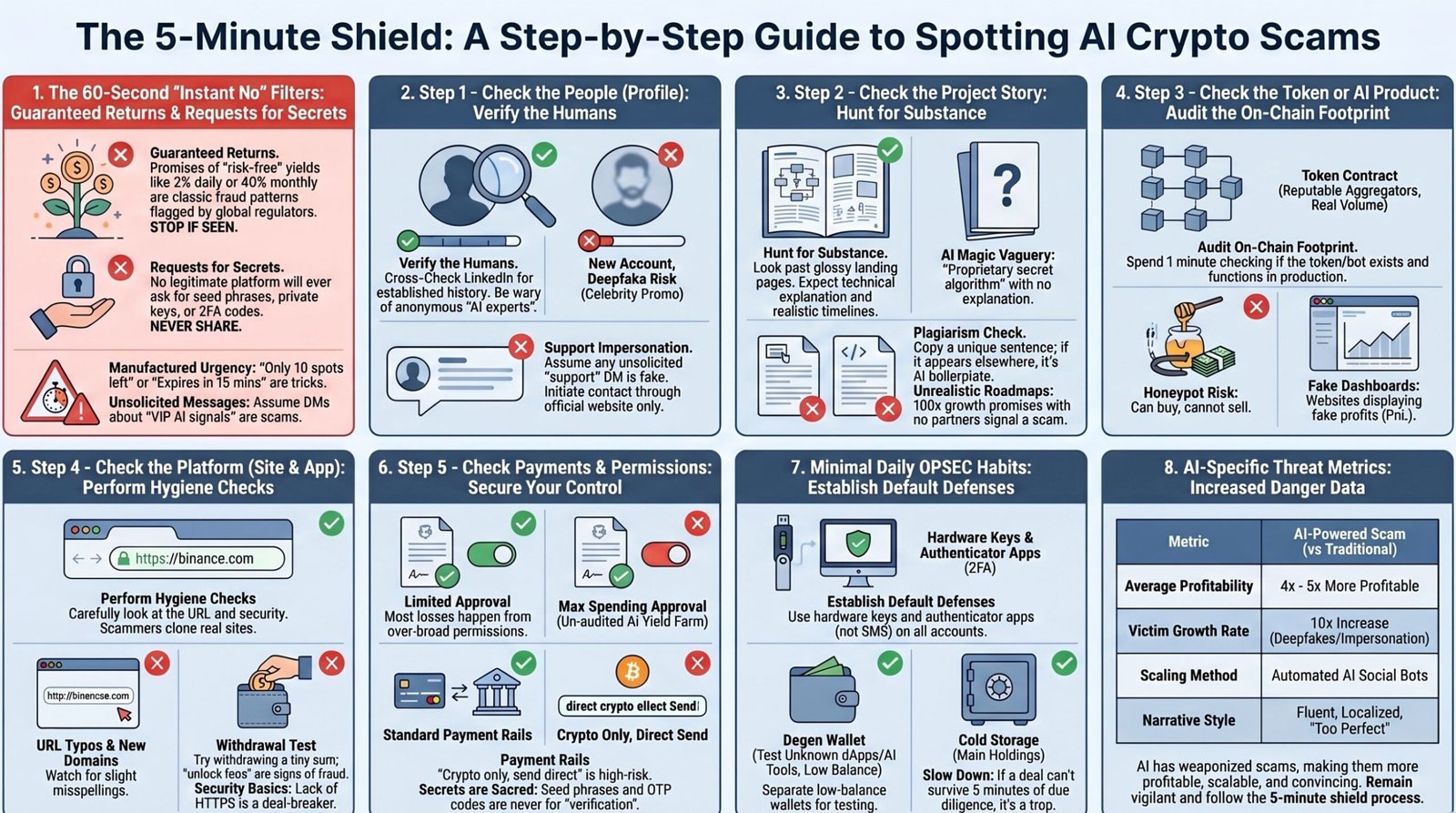

How to spot AI crypto scams in 5 minutes – step by step checklist infographic by Indi Crypto


The 60-Second “Instant No” Test

Before anything else, run this filter. If you see any of the following, stop immediately — you do not need more research.

  • Guaranteed or “risk-free” returns. Promises like “2% per day, “40% monthly guaranteed”, or “AI that never loses” are fraud patterns flagged by the CFTC, FINRA, and NASAA.
  • Requests for your seed phrase, private keys, or 2FA codes. No legitimate exchange, wallet, or trading bot will ever need these — full stop.
  • Extreme urgency and scarcity. “Only 10 spots left”, “offer expires in 15 minutes”, “deposit now or miss the pump” are pressure tactics designed to switch off your critical thinking.
  • They contacted you first. Unsolicited DMs on WhatsApp, Telegram, X, or Instagram about a “special AI opportunity” or “VIP signals group” are a classic entry point for scammers.
  • Fees to withdraw your own money. If a platform demands a “tax”, “unlock fee”, or “security deposit” before releasing your funds, you are almost certainly inside a scam.
  • Requests for remote access or screen-sharing. “Support” asking to control your phone or PC to “help” with a wallet is a direct path to a drained account.

Hit any of these? Close the chat, block the contact, and report it. No one is smart enough to outplay a professional scam operation — and trying costs you.


Step 1: Verify the People Behind the Project

AI has made fake humans terrifyingly convincing. Deepfake videos, AI-generated profile photos, and cloned voices are all standard tools in large-scale scam operations today. Your first job is to sanity-check the people.

Founders and advisors: Look them up on LinkedIn and other professional platforms. Do they have years of verifiable history, mutual connections, and previous roles you can actually confirm — or were their profiles created in the last few months?

Deepfake risk: Be sceptical of any video featuring a celebrity or CEO — Elon Musk, CZ, Vitalik, or prominent executives — promoting an “official AI coin” or offering to double your Bitcoin. Deepfake promo videos are now a standard, scalable tool in high-value scam operations, and AI-linked fraud has been measured as over four times more profitable than traditional schemes.

Support impersonation: On Telegram, Discord, and WhatsApp, assume any DM from “exchange support” is fake unless you personally initiated contact through the platform’s official website or app.

If the humans don’t check out, the project doesn’t deserve another minute of your time.


Step 2: Analyse the Project Story

Thanks to AI, anyone can generate a glossy whitepaper, a professional website, and a roadmap full of impressive-sounding milestones in an afternoon. You are hunting for substance behind the polish. Ask three quick questions:

Is the “AI magic” actually explained? Terms like “proprietary AI”, “secret algorithm”, and “can’t-lose strategy” with no technical detail, no data source, and no model description are precisely the kind of hype regulators warn about.

Is the content original? Copy a distinctive sentence from the whitepaper or website, paste it into Google, and see what comes up. If identical paragraphs appear across multiple unrelated projects, you may be looking at AI-generated boilerplate or plagiarism.

Is the roadmap grounded in reality? Promises of Tier-1 CEX listings, multi-chain deployment, and 100x growth within weeks — with no real funding, no verifiable team, and no existing partners — are classic red flags.

Real builders are specific. They are boringly honest about risks and transparent about what they cannot do yet.


Step 3: Check the Token or AI Bot On-Chain

If the people and story still hold up, take another 60–90 seconds to verify what actually exists on-chain and in production.

Listings and liquidity. Is the token listed on reputable aggregators like CoinGecko or CoinMarketCap with real trading volume and a meaningful history — or is it only available through a random DEX link someone sent you in a group chat?

Smart-contract basics. On a block explorer like Etherscan or BscScan, check whether the contract is verified, whether trading is open to all users, and whether fees or tax parameters are set suspiciously high.

Honeypot check. For meme-style AI coins launched on DEXs, run a dedicated honeypot checker tool and test with a tiny buy and sell from a fresh wallet. If you can buy but not sell, leave immediately.

Is there a working product? Many “AI trading bots” are nothing more than polished dashboards that accept deposits and display fabricated profit-and-loss numbers. No live app, no verifiable API connection to a real exchange, no audited smart contract — treat it as a marketing site, not an investment. If there is no product, you are not investing early. You are the product.


Step 4: Inspect the Platform (Site or App)

AI has made it cheap and fast to clone the look, feel, and branding of well-known exchanges and wallets. A quick platform check takes under a minute and can save you from handing your credentials to a fake Coinbase or Binance.

URL and domain age. Check the address letter by letter. Scammers register domains like coinbsae.com instead of coinbase.com, or use “brand-support” clones registered only weeks ago.

Security basics. No HTTPS padlock, certificate warnings, strange redirects, or a login screen asking for your seed phrase are immediate deal-breakers.

Test withdrawals first. On any unfamiliar platform, deposit a minimal amount and immediately attempt to withdraw it. Legitimate platforms make withdrawal straightforward. If the platform suddenly invents new fees, taxes, or “security verifications” the moment you try to withdraw, treat it as a confirmed scam.


Step 5: Check Payments and Wallet Permissions

Most serious financial losses happen in one of two ways: surrendering secrets or granting over-broad smart-contract permissions to a malicious address.

Secrets are sacred. Seed phrases, private keys, SMS one-time codes, and authenticator codes are never required to “verify” your account, “unlock” a reward, or “secure” your funds. Any request for these is fraud — without exception.

Wallet approvals. If an “AI yield farm” or “AI rebalancer” asks for a max spending approval on your stablecoins or established tokens, treat it the same as giving unlimited signing authority on your bank account. Only grant max approvals to audited, battle-tested protocols with years of track record — never to a project you found through a group chat link.

Payment methods. Reputable platforms support multiple payment rails, publish clear terms and conditions, and have identifiable legal entities. “Crypto only, send directly to this wallet address, no invoice, no company name” is high-risk territory.

If you hesitate even slightly while signing a transaction, that hesitation is your signal to stop and re-read exactly what you are authorising.


AI-Specific Red Flags to Watch in 2026

AI has not created new categories of fraud. It has made every old playbook dramatically more scalable and convincing. Here is what is growing fastest right now:

Deepfake endorsements. Live-streamed “giveaways” featuring deepfaked CEOs on YouTube, TikTok, and X have become routine. AI-linked scam operations are documented as generating over four times the revenue per victim compared to non-AI scams, driven largely by the credibility that realistic video lends.

AI-scaled social bots. Thousands of AI-written comments and direct messages — fluent in local languages and slang — can make a completely fake project look like the hottest opportunity in the market overnight. Chainalysis has documented a sharp rise in AI-driven impersonation and pig-butchering operations in its 2026 Crime Report.

Fake “investment education foundations”. Regulators like NASAA have documented schemes where “foundations” use WhatsApp groups, fabricated student success stories, and a “proprietary AI bot” hosted on a controlled exchange. Victims are given free tokens to build confidence, then encouraged to deposit real funds that are later blocked.

AI customer support impersonation. Voice-cloned “agents” and AI chatbots now impersonate banks, exchanges, and wallet providers, contacting users about “suspicious activity” or “account verification” with the goal of moving funds or extracting credentials.

The pattern is always the same: emotional pressure, manufactured urgency, and the promise that AI removes all risk from investing.


Daily Security Habits for the AI Era

You do not need to be paranoid. You do need updated habits. With average losses per victim rising sharply and AI making scams harder to detect on first impression, basic defensive routines are now non-negotiable.

  • Treat “too good to be true” as a hard no — especially when AI is cited as the reason there is no risk.
  • Use hardware wallets for meaningful holdings and enable 2FA or passkeys on all exchanges and email accounts, preferably via an authenticator app rather than SMS.
  • Maintain a dedicated “degen” wallet with minimal funds for testing unknown dApps, AI bots, and new protocols — keep your core holdings in cold or well-segmented storage.
  • Slow down under pressure. Scammers live off urgency and FOMO. If a deal cannot survive five minutes of this checklist, it is not an investment. It is a trap.

The bottom line: AI has made scams smarter, but it has also made verification tools, on-chain explorers, and credible information more accessible than ever. Make “verify first, invest later” your default setting — every single time.


Frequently Asked Questions

What are the most common AI crypto scams in 2026?
The most prevalent include AI trading bot frauds (fake dashboards showing fabricated returns), deepfake celebrity endorsements on YouTube and TikTok, pig-butchering romance scams using AI personas, and AI-impersonated customer support agents.

How do I know if an AI trading bot is a scam?
Check for an audited smart contract, a verifiable API connection to a real exchange, a publicly identifiable team, and a functioning withdrawal process. If any of these are missing — especially if withdrawals require extra fees — treat it as a scam.

What should I do if I’ve been scammed in crypto?
Stop sending money immediately, document everything (screenshots, wallet addresses, transaction IDs), report to your national financial regulator (e.g., CFTC in the US, FCA in the UK, BaFin in Germany), and report the wallet address to Chainalysis or your exchange’s fraud team.

Is it safe to use AI tools for crypto trading?
Legitimate AI tools exist and are used by professional traders. The key difference is that real platforms are audited, registered, transparent about risk, and do not guarantee returns. Any AI tool guaranteeing profits is either misleading or fraudulent.

How do deepfake crypto scams work?
Scammers generate realistic video or audio of celebrities, executives, or regulators using AI synthesis tools, then broadcast these as “live” events on social platforms, promoting fake coin launches or doubling schemes. The videos are often indistinguishable from genuine footage at first glance.


Sources

  1. Chainalysis – 2026 Crypto Crime Report: Scams [chainalysis.com/blog/crypto-scams-2026]
  2. Chainalysis – AI-Powered Crypto Scams: How AI Is Being Used for Fraud [chainalysis.com]
  3. Crypto.com University – Understanding AI Scams in Cryptocurrency [crypto.com]
  4. CFTC – Customer Advisory on AI-Themed Trading and Crypto Schemes [cftc.gov]
  5. FINRA – Artificial Intelligence and Investment Fraud [finra.org]
  6. NASAA – Elaborate Cryptocurrency Scams Involving AI Bots [nasaa.org]
  7. Quest CE – Regulators Caution Investors on the Promise of AI [questce.com]
  8. Walbi – AI Coin Scams & How to Spot Them [walbi.com]
  9. Coin.space – AI-Powered Crypto Scams: Real Examples 2026 [coin.space]
  10. Ohio Consumer Protection – AI-Powered Scams and How to Protect Yourself [com.ohio.gov]
  11. ESMA – Online Financial Frauds and Scams in an AI World [esma.europa.eu]
  12. Pronto Software – How to Protect Yourself Against AI-Powered Scams [pronto.net]

⚠️ Disclaimer: This article is for educational purposes only and does not constitute financial or legal advice. Always conduct your own due diligence before investing.

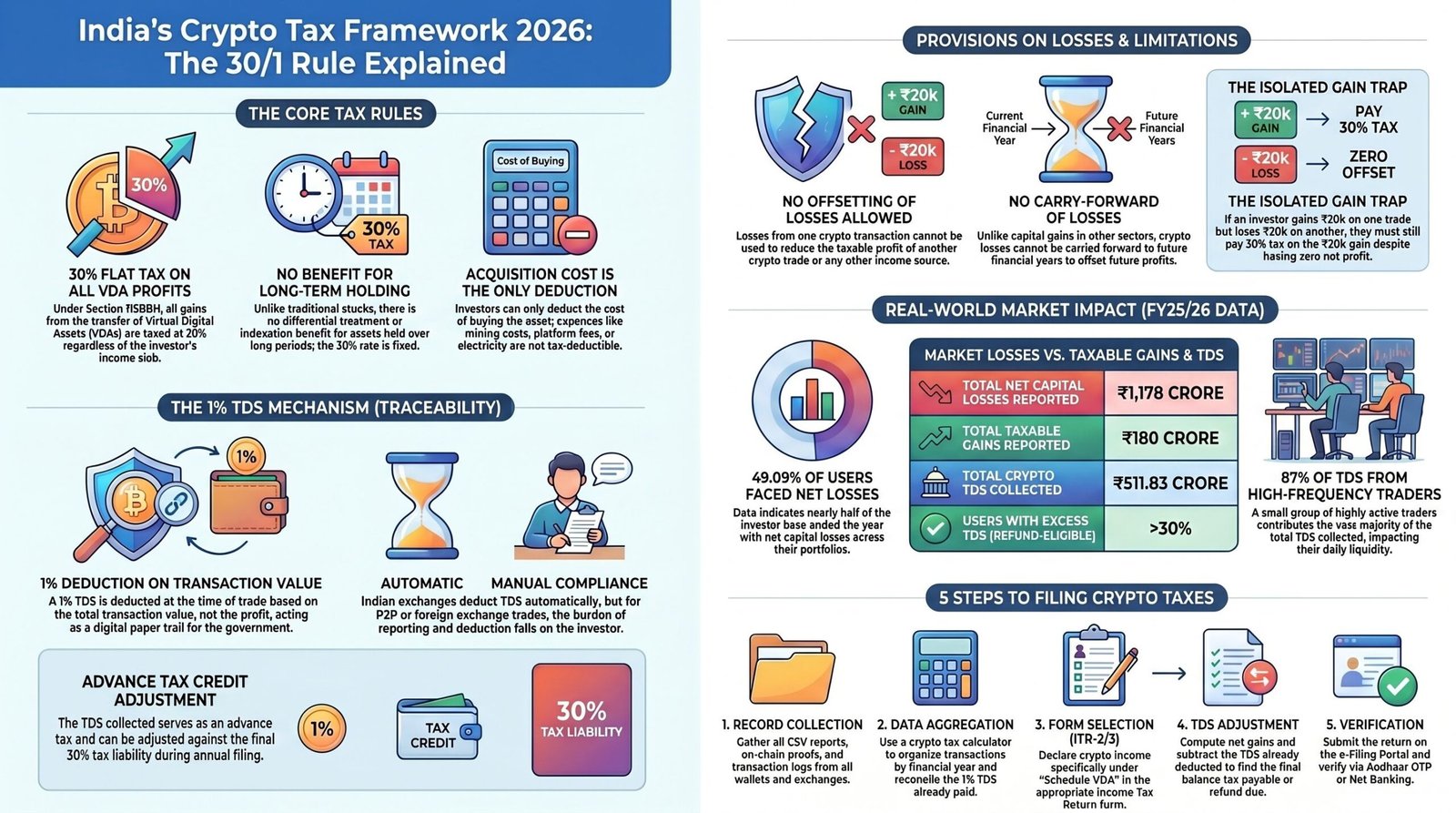
Crypto Tax India 2026: Complete Guide to 30% Tax & 1% TDS

India’s 2026 Crypto Tax Guide: Why You Can Lose Money Overall and Still Owe Tax

Crypto taxation in India presents a unique paradox: you can finish the year with a net loss yet still owe tax. Two key provisions drive this outcome:

  1. Section 115BBH taxes each profitable crypto transfer at 30%, with no set-off or carry-forward of losses.
  2. Section 194S mandates 1% TDS (tax deducted at source) on the transaction value (not on profit) to create a paper trail.

Master these two levers and you’ll understand your real tax and cash-flow drag before you trade—and file without surprises. (1)


Table of Contents

  1. Introduction
  2. Legal Framework and Taxation Principles
  3. Analysis of the 30% Flat Tax Rate
  4. Understanding the 1% TDS Mechanism
  5. Provisions on Losses and Their Limitations
  6. Practical Examples in Crypto Transactions
  7. Impact of Budget 2026 on Crypto Taxation
  8. Detailed Process for Filing Crypto Taxes
  9. Real-World Data and Case Study Insights
  10. Conclusion and Key Findings
  11. 2026 Legal and Financial Disclaimer
  12. Sources

1. Introduction

India’s Virtual Digital Asset (VDA) rules did not lighten in 2026. The Finance Act, 2026:

  • Retained the 30% tax on crypto gains under Section 115BBH and the 1% TDS under Section 194S.
  • Tightened reporting by introducing new penalties for entities that fail to furnish or misreport crypto-transaction statements.

The playbook to stay compliant is rigorous record-keeping and disciplined cash-flow management, rather than “netting” gains and losses. (2)

Background Note: Many jurisdictions allow loss harvesting or carrying forward losses, but India prioritizes uniform taxation and traceability over such reliefs, making the system predictable yet unforgiving.


2. Legal Framework and Taxation Principles

  • What is a VDA?
    Section 2(47A) defines a virtual digital asset (crypto, notified NFTs, and other notified digital assets). The government expressly excluded gift cards, reward/mileage points, and certain subscriptions from the VDA definition. (1)
  • Core tax provision (Section 115BBH):
    • Imposes 30% tax on income from the transfer of any VDA.
    • Only the cost of acquisition is deductible; platform feesinterestmining electricity, etc., are not deductible against VDA income.
    • No set-off against any other income and no carry-forward of losses. (1)
  • Withholding and tracing (Section 194S):
    • Requires 1% TDS on the consideration paid to a resident for a VDA transfer, with thresholds and mechanics detailed in CBDT Circular 13/2022.
    • The TDS base is the net consideration after excluding GST or other charges levied by the deductor.
      (5)
  • Filing requirement:
    Schedule VDA in ITR-2 (for non-business individuals) or ITR-3 (for business/profession) requires transaction-wise reporting; instructions ask for details of every transfer. (6)

Background Note: India’s philosophy emphasizes uniform taxation and strong traceability over granular reliefs common in securities taxation frameworks.


3. Analysis of the 30% Flat Tax Rate

  • Rate and base:
    • 30% applies to each transfer’s profit, calculated as sale value minus cost of acquisition.
    • Platform feesinterestmining electricity, and similar expenses are not deductible.
    • Cess and surcharge apply separately. (1)
  • Scope of “transfer”:
    • Applies whether you treat the activity as investment or business.
    • Section 115BBH(3) defines “transfer” broadly, covering all dispositions of a VDA. (1)
  • Gifts received:
    • If you receive VDA without consideration or for inadequate consideration, and the total value exceeds ₹50,000, it’s taxed under Section 56(2)(x) as Income from Other Sources.
    • Later disposal still qualifies for 30% taxation under Section 115BBH, with your tax‐paid receipt price becoming your cost of acquisition. (9)

Editorial note: A single special rate simplifies enforcement but removes reliefs investors typically have with traditional securities.


4. Understanding the 1% TDS Mechanism

TDS under Section 194S is not the final tax—it serves as a tracking tool and advance credit.

Key features:

  • Trigger: Payment of consideration for a VDA transfer to a resident.
  • Rate: 1% on the net consideration (after excluding GST/charges levied by the deductor).
  • Thresholds:
    • ₹50,000 per financial year for specified persons (certain individuals and Hindu Undivided Families).
    • ₹10,000 per financial year for others.
      (5)

Who must deduct TDS?

Platform TypeDeductorForm Filed / IssuedCitation
Indian centralized exchangesExchangeForm 26QF(11)
Peer-to-peer (P2P) transactionsBuyer (specified persons)Form 26QE (challan-cum-statement) and issue Form 16E(13)
Crypto-to-crypto swapsExchange (in kind)1% withheld on both legs, converted to INR deposit(11)
  • Residency check: If the payee is a non-resident, Section 195 may apply instead; professional advice is advised. (5)

Takeaway:

  • TDS can exceed your final liability and requires a refund claim when your actual tax is lower.
  • It creates a year-round cash-flow drag (roughly 1% of gross sell value).

5. Provisions on Losses and Their Limitations

  • No set-off: VDA losses cannot be offset against VDA gains or any other income. (1)
  • No carry-forward: Unused VDA losses cannot be carried into future years. (1)
  • Gifts: If taxed under Section 56(2)(x) on receipt, that amount becomes your cost of acquisition for future 115BBH calculations. (9)

Implication: You can be net-negative on the year and still owe tax on each profitable sell.


6. Practical Examples in Crypto Transactions

Note: Cess and surcharge are ignored for simplicity. TDS is calculated on “net consideration” (excluding platform charges/GST if levied by the deductor).

ExampleTransaction DetailsProfit/LossTax @ 30%TDS @ 1%Net Payable
ABuy ₹100,000 → Sell ₹120,000₹20,000 gain₹6,000₹1,200₹6,000 − ₹1,200 = ₹4,800 (1)
BTrade 1: +₹20,000; Trade 2: −₹20,000Net zero₹6,000 on gain1% on each sell value (~₹1,200 + ₹800)Loss cannot offset gain; tax still due on ₹20,000 gain (1)
CSwap ETH → SOL worth ₹50,000Depends on cost basisPay 30% on any gain vs ETH cost1% withheld in kindLater compute and pay on gains (11)
DP2P buy from resident: USDT ₹30,000N/AN/A₹300 (1%)Deductor (buyer) must file 26QE and issue 16E (11)

Rule of thumb for active traders: Expect a cash drag of roughly 1% of gross sell value or swap legs; refunds arrive only after assessment if your final 30% tax liability is lower.


7. Impact of Budget 2026 on Crypto Taxation

  • Core rates unchanged:
    • 30% under Section 115BBH
    • 1% TDS under Section 194S (24)
  • New platform-level penalties (effective April 1, 2026):
    • ₹200 per day for non-furnishing of crypto-asset statements.
    • ₹50,000 for inaccurate particulars or failure to correct under new Section 446 of the Income-tax Act, 2025 (as amended).
      These penalties target reporting entities, not retail holders. (2)
  • Enactment status: Finance Act, 2026 received Presidential assent on March 30, 2026. (26)

Editorial note: Budget 2026 doubles down on enforcement rather than granting reliefs (such as loss set-off or lower TDS) that the industry had lobbied for.


8. Detailed Process for Filing Crypto Taxes

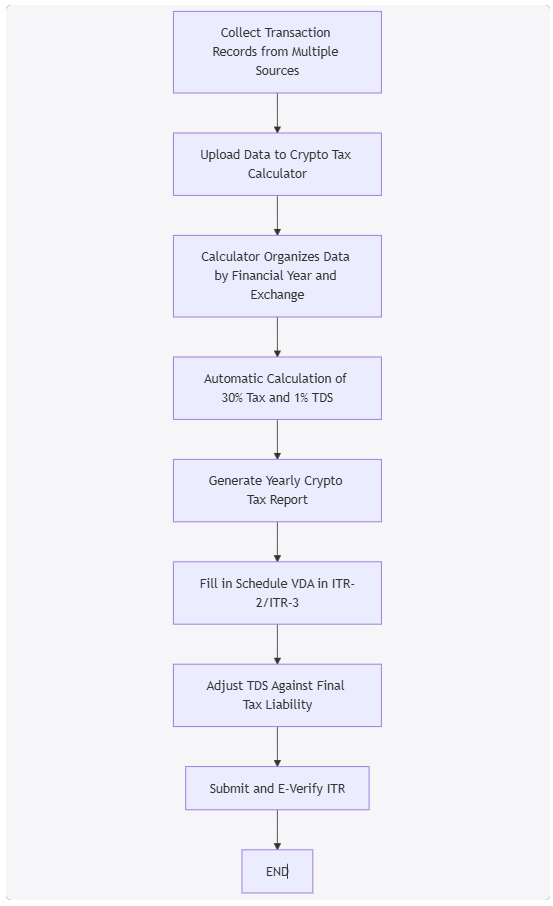
  1. Collect records
    • Exchange trade history (CSV), on-chain TXIDs, wallet addresses, P2P invoices, and any Form 16E/26QE issued or received.
    • Cross-check Form 26AS/AIS for TDS under Section 194S. (27)
  2. Use a crypto tax calculator (optional but practical)
    • Tools consolidate exchange and wallet data, compute per-trade profit/loss under Section 115BBH, and reconcile TDS credits for Schedule VDA. (28)
  3. Choose the right ITR and fill Schedule VDA
    • ITR-2 (no business income) or ITR-3 (business/profession).
    • Schedule VDA requires every transfer as a separate transaction. (6)
  4. Reconcile TDS
    • Exchange-deducted TDS (Form 26QF) should auto-appear in Form 26AS/AIS.
    • For your own P2P deductions as a specified person, ensure Form 26QE was filed and Form 16E issued; claim credit in your ITR. (11)
  5. File and e-verify
    • File by due dates. Under AY 2026-27 onward, general late-filing fees apply as per the Finance Act, 2026 (₹1,000 / ₹5,000). (2)

Do-this-now checklist:

  • Enable monthly exports on every exchange; tag P2P buys; keep TXIDs.
  • If you are a specified person buying on P2P, deduct 1% via Form 26QE and issue Form 16E on time.
  • Prior to filing, match your tool’s sell totals with the 26AS VDA TDS entries; address gaps to avoid “defective return” notices. (0)

9. Real-World Data and Case Study Insights

MetricValue / InsightSource
FY25 profit/loss mixKoinX’s FY25 cohort showed net capital losses of ~₹1,178 crore and taxable gains of ~₹180 crore.33
Offshore trading volume72% of trading volumes shifted offshore in FY25.33
TDS collectionsVDA TDS rose ~41% to ₹511.83 crore in FY25 (implying >₹51,000 crore of taxable turnover).34
State-wise leaderMaharashtra and Karnataka led in VDA TDS collections.34

Implication: The 1% TDS liquidity cost is material for high-frequency traders—refunds arrive later, but the drag is real during the year.

Edge debate—derivatives:
Industry commentary suggests that cash-settled crypto futures/options may not be VDAs and could be taxed as (speculative) business income rather than under Section 115BBH. No CBDT-level clarification exists yet. If you trade derivatives, document your position and consult a tax professional. (35)


10. Conclusion and Key Findings

  • 30% on each profitable transfer, with cost-only deduction and no loss set-off or carry-forward. (1)
  • 1% TDS is on value (net of platform charges), not profit; thresholds are ₹50,000 / ₹10,000 depending on taxpayer category; exchanges and P2P participants have distinct responsibilities. (11)
  • Budget 2026 maintained rates and added penalties to enforce cleaner reporting at the platform level. (2)
  • Filing in 2026 requires accurate Schedule VDA, thorough TDS reconciliation (26QF/26QE/16E), and timely e-verification. (6)

Light take: In India, crypto tax planning centers on trade-by-trade hygiene and cash-flow discipline, not classic tax-loss harvesting.


2026 Legal and Financial Disclaimer

This guide is for general information and education on India’s crypto tax regime as of April 30, 2026. It is not legal, tax, or investment advice. Laws, circulars, forms, and portal behavior can change and may apply differently to your facts (e.g., residency, source of income, business vs. investment treatment, and derivative products). Consult a qualified tax professional before acting. Indi Crypto and the author assume no liability for decisions made based on this guide.


Sources:

Why Bitcoin Matters When the World Is on Fire?


If you’re watching the news these days—wars in Ukraine and Gaza, unrest in Iran and Venezuela, political chaos in the US—you’re probably wondering: What does all this mean for my money? That’s the right question to ask. Because while the headlines change, the pattern behind the chaos is as old as civilization itself.

Trust, Crisis, and the Flight of Capital

Whenever people lose trust in institutions—governments, banks, even currencies—capital doesn’t just sit still. It flows outside the traditional system. This isn’t a new phenomenon. For 5,000 years, from the Roman Empire to the 20th century, every major crisis has triggered a rush for safety. And for most of modern history, that safe haven has been gold.

After every major crisis since 1971, gold prices surged. Why? Because gold is the classic store of value—something that holds its worth when everything else is in doubt. But there’s a twist this time. The world isn’t just anxious about one country or one region. It’s anxious about the system itself. Even the Eurasia Group, a top geopolitical risk firm, named America as the number one global risk for 2026. That’s never happened before. And it’s why central banks bought over 1,000 tons of gold last year—for the third year running.

Gold’s Limits in a Modern Crisis

But gold, for all its history, has a problem in today’s world. It’s a store of value, but it’s not a mechanism of escape. When Ukrainian refugees fled in 2022, they faced closed borders and frozen banks. Try crossing a military checkpoint with gold bars in your bag—you’ll lose it all. But a USB stick holding millions in Bitcoin? That walks right through.

Bitcoin: The Digital Escape Hatch

That’s why Bitcoin is up 450% while gold is up 150% in recent years. We’re not saying Bitcoin replaces gold entirely. But we are saying that every major wealth transfer in history has happened when trust breaks down. And in a world where chaos is everywhere—not just out there, but right here—the smartest investors are looking for assets that work both as a store of value and a portable escape hatch.

The Real Question for Indian Investors

So, the question isn’t whether this chaos will impact your money. It’s whether you’ll be positioned for it—or caught off guard by it. In times like these, understanding the new rules of wealth isn’t just smart. It’s essential.

Disclaimer: This article is for educational purposes only. Cryptocurrency investments are subject to market risks. Please consult a qualified advisor and always comply with Indian regulations before investing.

5 Things Everyone Gets Wrong About India’s 2025 Crypto “Crackdown”

For years, India’s cryptocurrency industry operated in a grey zone—neither formally recognised nor outright banned. This uncertainty left investors and entrepreneurs in a state of constant suspense. But 2025 marked a pivotal shift. Contrary to the widespread fear of an outright ban, 2025 was the year India finally gave its crypto industry a regulatory spine, reshaping how exchanges operate, how users trade, and how authorities enforce the rules. This overhaul pulled crypto out of the shadows and into a defined compliance framework.

Here are five of the most surprising and impactful truths about this regulatory transformation.

The Goal Wasn’t a Ban—It Was Legitimacy

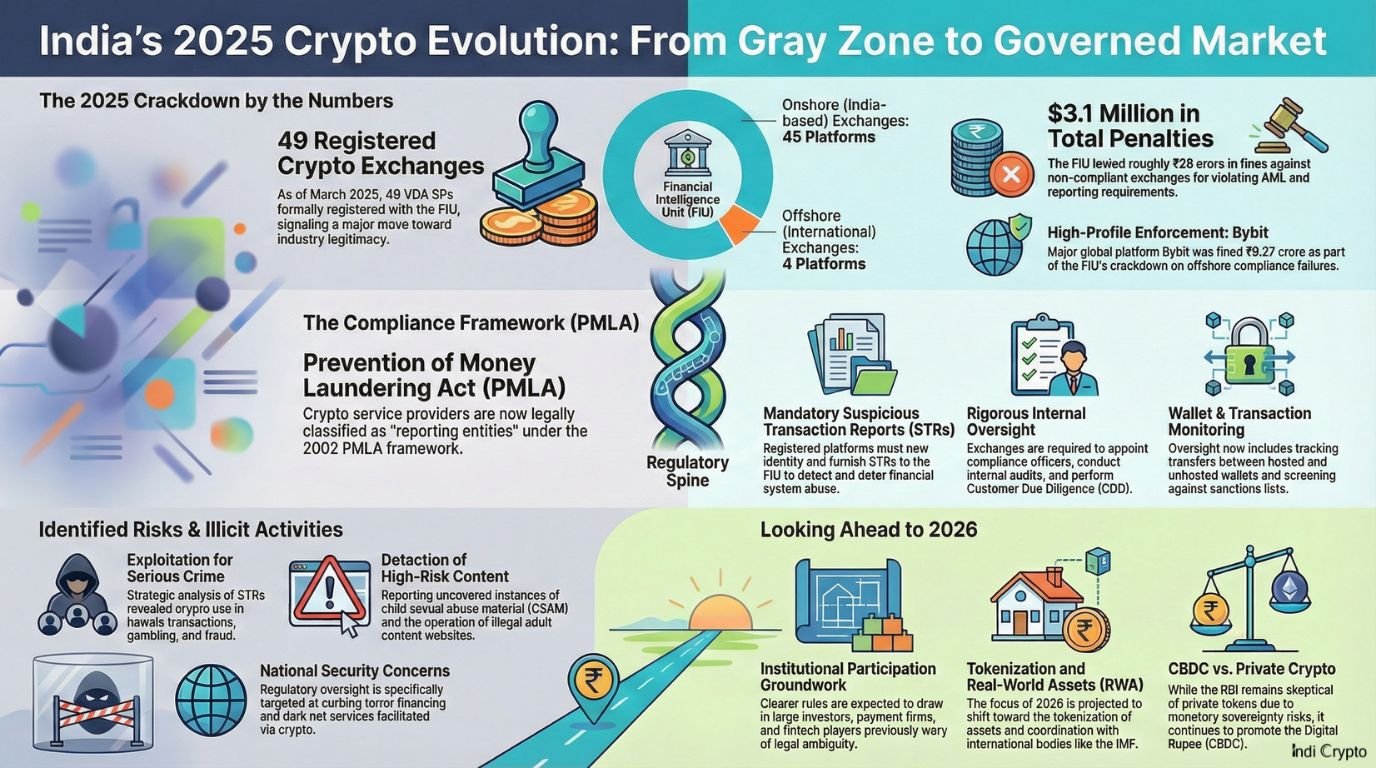
The primary purpose of the 2025 policy shift was not to eliminate crypto but to pull the industry out of regulatory limbo. This was achieved by bringing all virtual digital asset service providers under the purview of India’s Prevention of Money Laundering Act (PMLA). The regulator’s objective was clear: reduce the risks associated with money laundering and terror financing without shutting the door on legitimate crypto activity. For exchanges, this meant higher operational costs but also newfound regulatory legitimacy.

The message is clear: crypto can operate in India—but only within the rules.

One Financial Watchdog Is Now in Charge

Unlike many countries where multiple agencies supervise crypto, India designated a single-point authority to oversee the entire ecosystem: the Financial Intelligence Unit (FIU), which operates under the Union Finance Ministry. This centralised approach contrasts sharply with the fragmented regulatory landscapes in countries like the U.S., positioning the FIU as an undisputed authority and eliminating jurisdictional ambiguity. The FIU imposed a new registration mandate and a strict set of rules for all registered exchanges.

New compliance requirements include:

  • Submitting Suspicious Transaction Reports (STRs) to flag potential illicit activity.
  • Appointing designated directors and principal officers to ensure accountability.
  • Implementing internal audits and periodic risk assessments.
  • Conducting rigorous Customer Due Diligence (CDD) and Enhanced Due Diligence (EDD).
  • Screening all transactions against global sanctions lists.
  • Monitoring wallets and tracking transfers between hosted (exchange) and un-hosted (private) wallets.

These measures weren’t theoretical; the FIU’s analysis of STRs from these exchanges quickly uncovered the exploitation of crypto for serious crimes, from hawala transactions to darknet services, validating the regulator’s aggressive stance.

The Numbers Are Staggering: 49 Registrations and $3.1 Million in Fines

The FIU’s regulatory push delivered swift and measurable outcomes by March 2025. A total of 49 cryptocurrency exchanges successfully registered with the regulator, including 45 based in India (“onshore”) and four operating from abroad (“offshore”).

Alongside registration came decisive enforcement. The FIU levied penalties totalling approximately ₹28 crore (about $3.1 million) against exchanges found to be in violation of anti-money laundering and reporting requirements. In one of the most prominent cases, the global platform Bybit was fined ₹9.27 crore, sending a clear signal that non-compliance would not be tolerated. This was not an isolated case, as the FIU has launched probes into other global platforms over tax compliance and reporting failures.

Tension Remains Between Regulators and the Central Bank

Despite the FIU’s new framework, a core challenge remains: the Reserve Bank of India’s (RBI) long-standing institutional scepticism toward private cryptocurrencies. The RBI has repeatedly warned that private crypto assets pose significant risks to financial stability and monetary sovereignty. While its previous banking restrictions no longer stand, the central bank continues to favor its own central bank digital currency (CBDC) over privately issued tokens.

This underlying tension means India’s regulatory story is far from finished. With dozens of exchanges now operating under FIU oversight, pressure is building for a more comprehensive framework that goes beyond anti-money laundering enforcement.

India’s actions in 2025 were a turning point, not a final destination. The overhaul established clear rules for crypto’s existence rather than moving to destroy it. The country has drawn a firm line between compliant innovation and unchecked activity.

The industry now looks ahead to the next phase of regulation, which will likely address complex topics like the tokenization of real-world assets (RWA) and the legal framework for stablecoins. This sets the stage for a fundamental question about the nation’s role in the new digital economy.

What comes next will determine whether India becomes a tightly regulated participant in the global digital asset economy, or simply a cautious gatekeeper watching from the sidelines.